
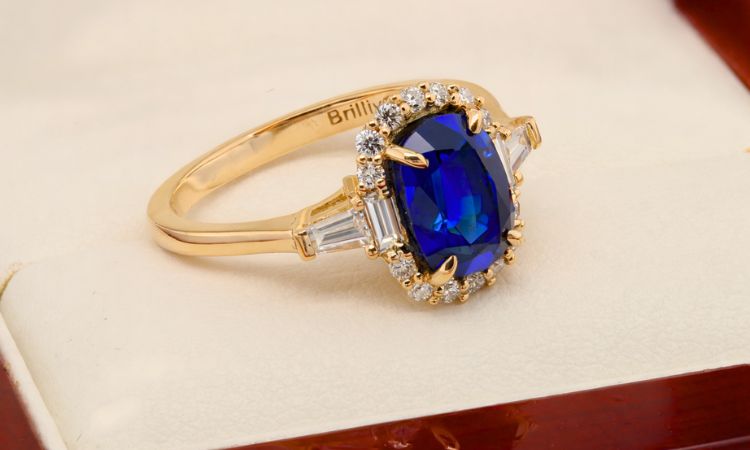
The 6Cs of Sapphires by Brilliyond - C4.Carat
The 4Cs of diamonds - Cut, Colour, Clarity, and Carat are an industry-accepted framework used to grade and describe diamonds. However, sapphires are far more complex gemstones, and their value cannot be accurately explained using the same criteria alone.
To better reflect how sapphires are evaluated in practice, Brilliyond introduced the 6Cs of Sapphires, incorporating two additional factors that are widely used in the sapphire trade. The fourth C is Carat, which refers to the weight of the sapphire.
What Is a Carat?
A carat is a unit of weight equal to 0.2 grams. Each carat is divided into 100 points (pt). For example, a 0.75 ct sapphire may also be described as a 75-point stone.
As a general reference, a well-proportioned 1-carat sapphire typically measures around 6mm, although actual dimensions vary depending on the cut style, depth, and shape.
Sapphire Carat Weight and Value
Keeping all other quality factors constant, such as colour, clarity, cut quality, and treatment status, the value of a sapphire increases as its carat weight increases. This relationship is fundamental to gemstone valuation.
Importantly, this increase in value is not linear. A 2-carat sapphire is not simply worth twice as much as a 1-carat sapphire of the same quality. Instead, sapphire pricing generally follows an exponential curve, where larger stones command disproportionately higher prices due to their increasing rarity.
Sapphire vs Diamond: Visual Size Differences
Sapphires and diamonds have different physical properties. Sapphires are denser than diamonds, meaning they weigh more for a given volume. As a result, a sapphire and a diamond of the same carat weight will not appear the same size. A 1-carat sapphire will usually look slightly smaller than a 1-carat diamond.
For this reason, carat weight should always be considered alongside actual millimetre dimensions when comparing gemstones.
Weight Preservation and Cutting Decisions
Because carat weight has a strong influence on value, gem cutters often prioritise weight retention during the cutting process. In some cases, cutters may deliberately avoid an ideal or perfectly symmetrical cut if achieving that cut would reduce the stone’s weight below a key threshold, such as 1 carat.
As a result, some sapphires may display:
-
Slightly deeper proportions
-
Minor asymmetry
-
Less-than-ideal outline shapes
These characteristics can be a deliberate choice to preserve carat weight, rather than a lack of craftsmanship. This practice reflects the market reality that a higher carat weight can outweigh small compromises in cut, provided the other quality factors remain strong.


 Schedule a Zoom Call
Comments (0)
Write your review